Ask an American engineer how to "certify" an autonomous forklift and you will get a longer answer than the European one. The United States has no single CE-equivalent mark. Instead, compliance is assembled from three layers: federal law (OSHA), voluntary consensus standards (ANSI), and third-party product listing (UL/NRTL). Understanding how these layers stack is the difference between a vehicle that can legally work and one that only looks finished.
The legal layer: OSHA and the General Duty Clause
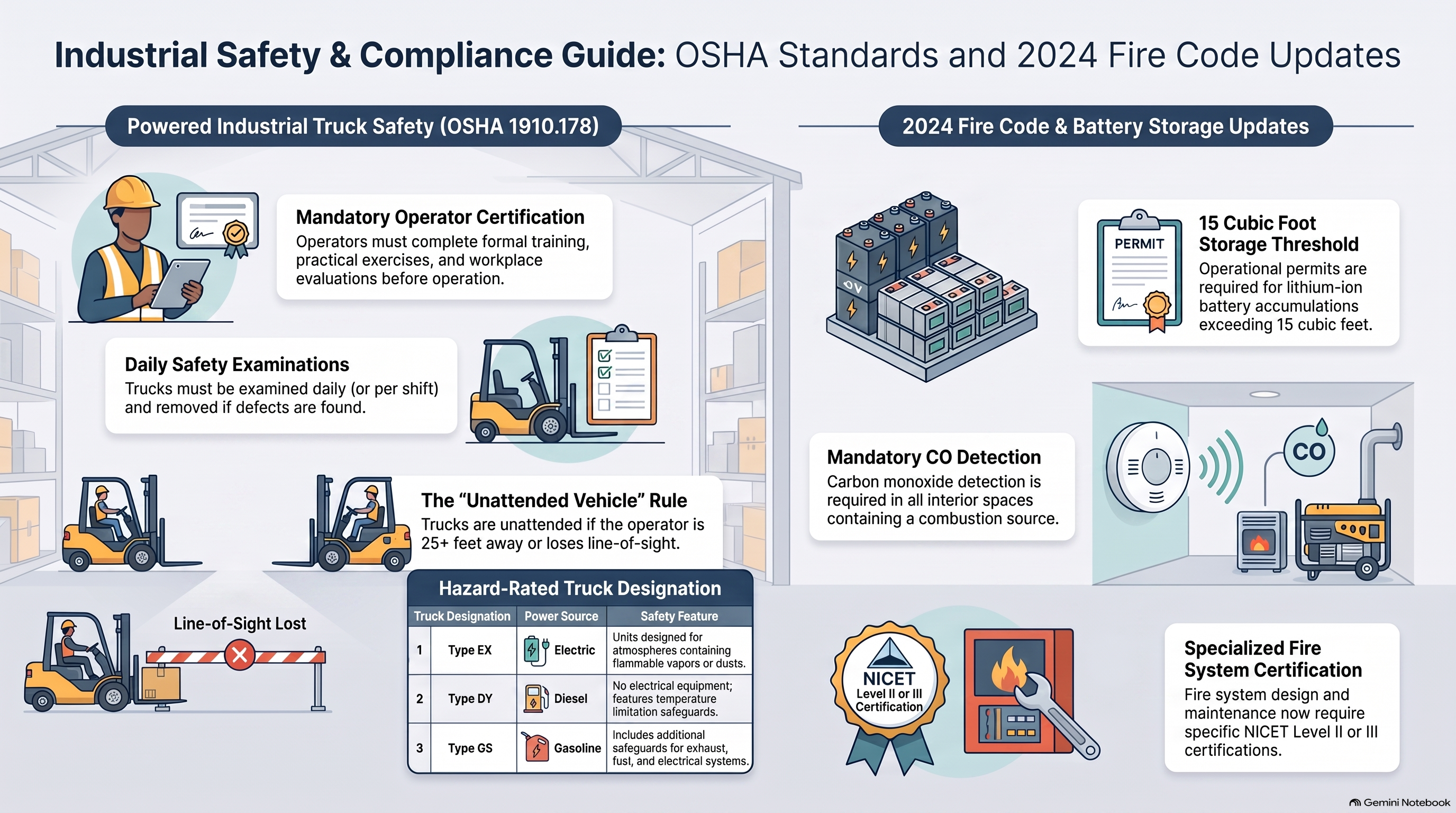
The federal foundation is the Occupational Safety and Health Act, enforced by OSHA. For powered industrial trucks — forklifts included — the operative regulation is OSHA 1910.178. But here is the first thing most teams miss: 1910.178 was written for manned forklifts.
An autonomous, driverless truck has no operator to certify, no driver seat, no mast visibility concerns in the same sense. It falls into a regulatory gap. OSHA still applies — through the General Duty Clause (Section 5(a)(1)), which requires every employer to provide a workplace "free from recognized hazards." But the specific, prescriptive requirements live in the voluntary ANSI standards, not in federal law.
| Layer | Instrument | Binding? | What it covers |
|---|---|---|---|
| Federal law | OSHA 1910.178, General Duty Clause | Legally binding | Operator training, safe operation, hazard-free workplace |
| Consensus standards | ANSI/ITSDF B56.5, ANSI/RIA R15.08 | Voluntary, but cited by OSHA & courts | Vehicle design, safety functions, risk assessment |
| Electrical/fire | NFPA 79, NFPA 70 (NEC) | Adopted by local AHJ | Wiring, emergency stop, charging infrastructure |
| Product listing | UL 3100, UL 508A | Voluntary, required by insurance/AHJ | Third-party certification of the platform and panels |
The vehicle standards: B56.5 vs R15.08
Two ANSI standards divide the field, and the distinction is a matter of how the vehicle navigates:
- ANSI/ITSDF B56.5 — the older standard for driverless AGVs: vehicles that follow a fixed physical or virtual guidepath (magnetic tape, inductive wire, QR grid). When an AGV detects an obstacle, it stops and waits.
- ANSI/RIA R15.08 — the newer standard for Industrial Mobile Robots (IMRs): vehicles that navigate dynamically via SLAM and re-plan their own path around obstacles. It is the closest US counterpart to ISO 3691-4.
R15.08 is the standard that actually matches a modern autonomous forklift. It is published in three parts:
| Part | Year | Scope |
|---|---|---|
| Part 1 | 2020 | Safety requirements for the IMR itself |
| Part 2 | 2023 | Requirements for the IMR system / integration |
| Part 3 | in development (at the time of writing) | User / operator requirements |
R15.08 introduces the safety functions that matter for autonomy, the two most important being safety-rated monitored speed and safety-rated monitored stopping — the vehicle's speed and stopping behavior are themselves monitored by a safety-rated channel, not just commanded by the navigation stack.
The risk assessment: ANSI B11.0
Where the EU starts with ISO 12100, the US starts with ANSI B11.0 — the general machinery safety standard and the counterpart to ISO 12100. The process is the same shape: identify hazards, estimate risk, apply the hierarchy of controls (elimination → engineering controls → warnings → training), document residual risk.
The critical difference is who checks the work. In the EU, a Notified Body may be legally required. In the US, the risk assessment is self-performed, and its adequacy is tested only after an incident — by an OSHA citation or a product-liability lawsuit.
Functional safety: still ISO 13849 / IEC 62061
Here is the nuance that surprises people. The US does not have its own functional-safety math. When an American engineer determines a Performance Level or a SIL, they use the same IEC 61508 / IEC 62061 / ISO 13849 framework as a European engineer. The ANSI standards reference these for the underlying calculation.
What changes is the machine-level wrapper. The EU wraps functional safety in ISO 3691-4; the US wraps it in R15.08. The math is identical; the container is different.
Electrical: NFPA 79 and NFPA 70
Electrical compliance follows NFPA 79 (electrical standard for industrial machinery — the US counterpart to IEC 60204-1 / VDE 0113) and NFPA 70 (the National Electrical Code). The same stop categories apply — Category 0 (immediate power removal), Category 1 (controlled stop then removal), Category 2 (controlled stop, power maintained) — but the wiring conventions, conductor color codes, and grounding requirements differ from IEC.
The charging infrastructure for battery-powered forklifts also falls under the NEC, and local Authorities Having Jurisdiction (AHJs) enforce it.
The listing: UL 3100 and the NRTL process
The closest US analogue to the CE mark is third-party listing by a Nationally Recognized Testing Laboratory (NRTL) — UL, ETL, TÜV SÜD America, and others. For autonomous mobile platforms, the base standard is UL 3100 (Automated Mobile Platforms) — but note its scope excludes vehicles with lifting forks, so an autonomous forklift is evaluated under UL 583 (electric battery-powered industrial trucks), with UL 508A covering the control enclosure. Part 3 of this series returns to that distinction.
Listing is technically voluntary. In practice it is effectively mandatory: insurance underwriters require it, AHJs demand it, and major customers write it into purchase contracts. A forklift without a UL listing is a forklift you cannot insure and cannot sell to an enterprise.
The compliance roadmap
flowchart TD
    A["Risk assessment (ANSI B11.0 / R15.306)"] --> B["Functional safety design<br/>ISO 13849 / IEC 62061, per R15.08"]
    B --> C["Electrical compliance<br/>NFPA 79, NFPA 70, UL 508A"]
    C --> D["NRTL listing<br/>UL 3100, ETL, TÜV SÜD America"]
    D --> E["OSHA compliance<br/>General Duty Clause, 1910.178 where applicable"]
    E --> F["Documentation<br/>risk record, validation, operator manuals"]
The absence of a single gate means the burden shifts to diligence. A manufacturer documents everything — the risk assessment, the functional-safety calculations, the validation tests — because that documentation is the only defense in a lawsuit or an OSHA inspection. The process is not lighter than the EU's; it is just distributed across more institutions, none of which is mandatory until it suddenly is.
What this means in practice
The practical takeaway is a reversal of the common assumption. The US is not the "easier" market. It has no single authority that stamps approval, which means the manufacturer carries more of the burden of proving safety proactively. The EU gives you a clear gate (the CE mark, possibly with a Notified Body); the US gives you a liability landscape you navigate yourself.
For a team building an autonomous forklift, the sequence is the same as anywhere: risk assessment first, autonomy stack second. The zones, the speed limits, the safety functions, and the hardware choices all flow from the risk assessment — whether that risk assessment is later checked by a Notified Body (EU) or a plaintiff's attorney (US).
This post draws on the ANSI/ITSDF B56.5, ANSI/RIA R15.08, ANSI B11.0, and ANSI/RIA R15.06 standards, OSHA 1910.178 and the General Duty Clause, NFPA 79 and NFPA 70, and the UL 3100 / UL 508A listing requirements.
Next: Part 3 — EU vs US: Two Ways to Certify an Autonomous Forklift