I did not set up a personal AI assistant and then walk away. I run one every day: German B1, a large Obsidian vault, study videos, YouTube explainers, this website. The stack changed three times. The job did not.
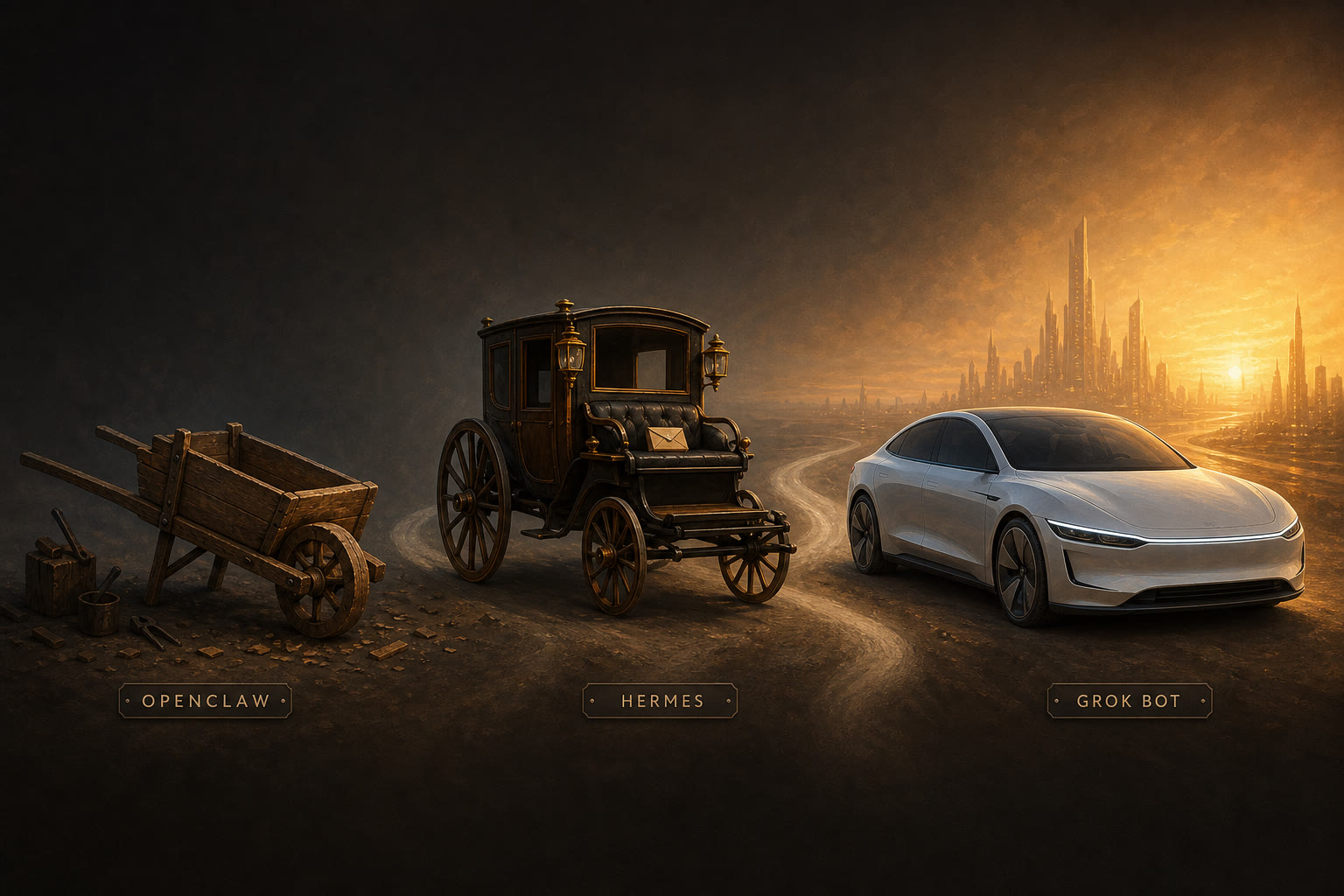
If OpenClaw was inventing the wheel and bolting it onto a wheelbarrow, Hermes was a horse-drawn carriage (more comfortable, still analog), and Grok Bot is the electric car. Same road. Less fighting the vehicle.
Why an assistant at all
I do robotics and software for a living, and I also run a second brain, a language course, a public technical blog, and a YouTube channel of explainers. None of that is "chat with a bot for fun." The useful assistant is the one that:
- files a note the same day I think of it
- turns a study session into something I can rewatch
- ships a blog post or a video without me copying files by hand
- nags the German homework without nags at 2am
- never emails anyone, never deletes a file, never invents a secret
That last line is load-bearing. The assistant is a colleague with a deny list, not an intern with root.
Generation 1 — OpenClaw (the wheelbarrow)
The first generation lived in a private GitHub repo (it started life as "Charlie", I called it Rookie) on a hardened Hetzner VPS. OpenClaw in Docker. Telegram only. Google Workspace via CLI. Obsidian synced through Drive. UFW, fail2ban, encrypted backups, git-push-to-deploy.
It worked. It also demanded that I be the harness. Bootstrap the VPS. Pair Telegram. Drop API keys into .env over SSH. When an OAuth screen appeared there was no desktop, so I did the dance from a laptop and copied tokens. Cron jobs vanished on restart. The environment was spaghetti: host scripts, container scripts, leftover names, a security model I had to keep in my head.
I still use everything I learned there. The wheel was real. The barrow was a lot of wood for one wheel.
Generation 2 — Hermes (the carriage)
Hermes (Nous Research's hermes-agent) replaced Rookie on the same VPS. Same Telegram-first life, better internals: skills on disk, a nightly self-sync, a robotics wiki that compounds, a filesystem CMS for this site, YouTube uploads through the Data API, NotebookLM for study artifacts.
It was a better carriage. I still had to meet it on Telegram. Adding a new key or approving a Google screen still meant inventing a path around a machine with no display. Two Telegram bots (ops vs German tutor) because one poller cannot share a token. Heartbeats had to be tuned down from "every 30 minutes" to "every six hours, and stay quiet unless it matters."
Hermes is still running. I did not burn the carriage to build the car.
What it actually carries
Skip the product names for a minute. This is the work:
Language. Goethe B1. Session notes land in the vault after class. Vocab and grammar get a morning and evening pass. The tutor is a separate persona so ops chat does not turn into a classroom.
Notes. A PARA-ish Obsidian vault plus a wiki that is supposed to grow every time a durable fact shows up. Capture first, file in the evening, never delete — archive. If I say "remember this," it becomes a file, not a vibe.
Study media. NotebookLM turns a session or a paper into slides, a video, a quiz. I watch the artifact in NotebookLM. The assistant triggers generation and reports status. It does not dump MP4s into chat.
YouTube. Technical series (fleet protocols, simulation labs, CI/CD) get uploaded through the YouTube Data API: title, description, privacy, thumbnail. Then the same video is embedded on this site as a lone paragraph link, because that is the only form that becomes a player.
This website. Posts and project pages are markdown on a Docker volume. Publish is: write the file, revalidate, mirror the vault, open the live URL and look. No silent "it built, so it rendered."
Ops. Calendar and mail get a glance. Mail is draft-only. Calendar creates are fine; deletes wait for a yes. Quiet hours at night.
None of that is a demo. It is how a week actually looks.
Generation 3 — Grok Bot (the electric car)
Grok Bot is the first version that feels like a computer I can sit next to: a real desktop, a browser for logins, connectors for Gmail and Calendar, the same Obsidian vault via Sync, SSH over Tailscale to the VPS I already paid for.
The difference is not "smarter model." The difference is surface area. When YouTube OAuth expires I refresh it on a screen. When I want a cover image for a post I ask for one. When German tutoring should not live in the ops thread, I spin a specialist agent and keep Chief of Staff on calendar and the site.
This post is the first site task I gave that stack: read the old OpenClaw repo, keep Hermes' rules, write here, put the image next to the markdown, revalidate, check the live page.
What I refuse to "upgrade" away
- Never delete a note. Archive.
- Never send email without an explicit yes.
- Never put secrets in the vault or in a blog post.
- Telegram can stay until the new surface is boringly reliable. I am not burning a working colleague to look modern.
The point of three generations is not a rebrand. It is this: I kept the job, and I stopped spending my evenings being the glue.
If you want the earlier snapshot of generation 1, I wrote Hello, World: Meet Rookie. The knowledge pipeline around vault + NotebookLM is here.