
I burn Claude and Cursor tokens the same way a lot of engineers do: default to the strong model, then notice the bill after a week of “quick fixes.” Most of those turns did not need Opus. Some did not need an LLM at all. The fix is not a spreadsheet of vibes — it is a cheap, typed gate that runs before generation.
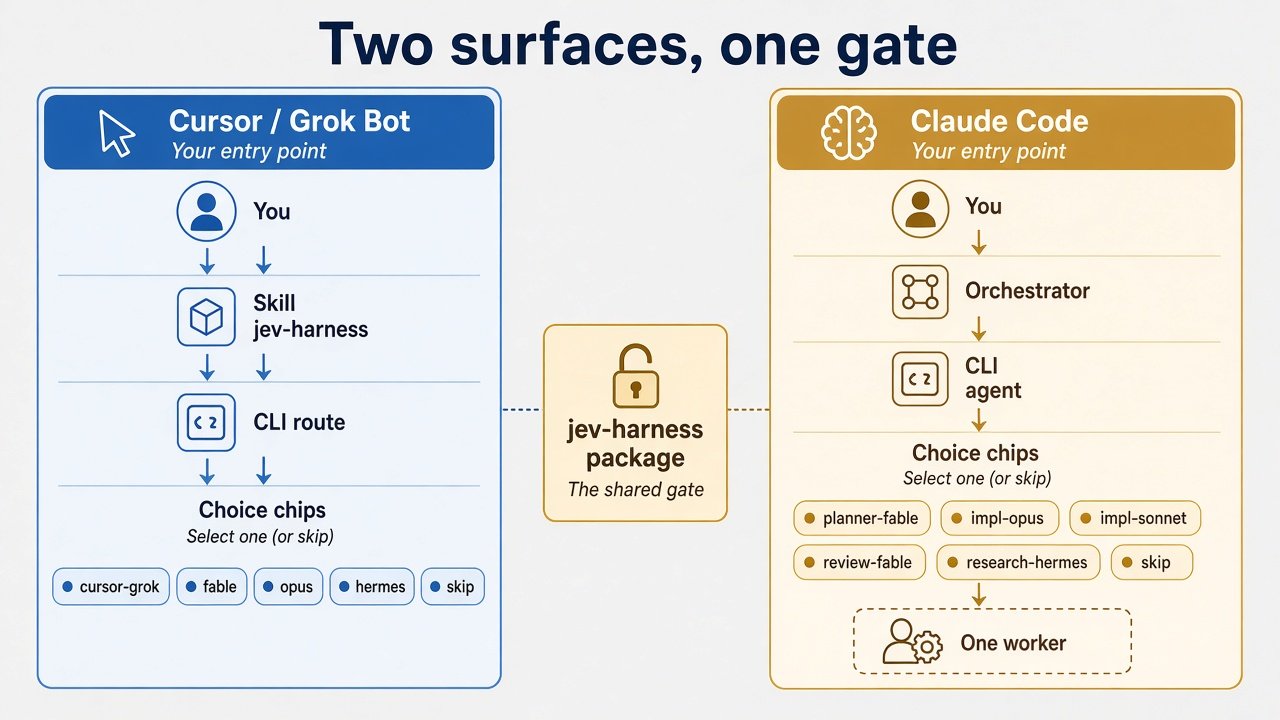
That gate is TypeSafe Jev (System One), wrapped in a small package we call jev-harness. Same library, two surfaces: Cursor picks which model to wake; Claude Code picks which worker runs next. Code owns control flow. Jev only returns Choice / Noul / Score over a closed set.
System One vs System Two (plain words)
System One here means: fast judgment over a closed option list. You hand Jev a short goal plus compact JSON context. It returns something like cursor-grok or planner-fable, plus a confidence and an optional “this needs expensive reasoning” signal. No prose plan. No code. No vision.
System Two is the expensive part you already know: Cursor Grok writing a patch, Fable drafting architecture, Opus doing a hard multi-file impl, Hermes chewing a long research draft.
The TypeSafe docs call this pattern Harness Engineering / Model routing. We already proved the same idea on a computer-use spike: Jev Choice over action ids beats scraping UI labels. Coding harness is the same gate, pointed at models and agents instead of buttons.
Shared package: jev-harness
Package path: /workspace/jev-harness.
Python surface:
route_task— Cursor-side model routeroute_agent— Claude-side worker route (ratified multi-agent orchestrator)select_option— pick among labeled options (PRs, tools, files)should_escalate— Noul / Choice escalate check- CLI:
python -m jev_harness.cli {route|agent|select|escalate|spend}
Hard rules we keep in v0:
- Serial workers only — one expensive worker at a time
- Jev never writes code — text/JSON judgments only
- No vision — compact state JSON, no screenshots
- Spend proxy cap for spikes:
JEV_HARNESS_CAP_USD=0.50
Cursor surface — model route
On Cursor we install a skill named jev-harness, next to the upstream typesafe-ai skill from github.com/typesafe-ai/skills. Before opening Opus, Fable, or a long Hermes run, the agent calls the CLI:
python -m jev_harness.cli route "Fix reconnect timeout in bridge.py" \
  -c '{"repo":"amr-agent"}'
Closed Choice set:
| Choice | Meaning in this stack |
|---|---|
cursor-grok |
Standard coding — stay in Cursor / Grok |
fable |
Plan / architecture / tradeoffs |
opus |
Hard novel impl, subtle multi-file invariants |
hermes |
Long research / draft capacity |
skip |
Rules, scripts, or context enough — no LLM |
Parallel Noul needs_expensive_reasoning: if ≥ 0.55, treat as escalate even when Choice was cheap — confirm before waking Opus/Fable.
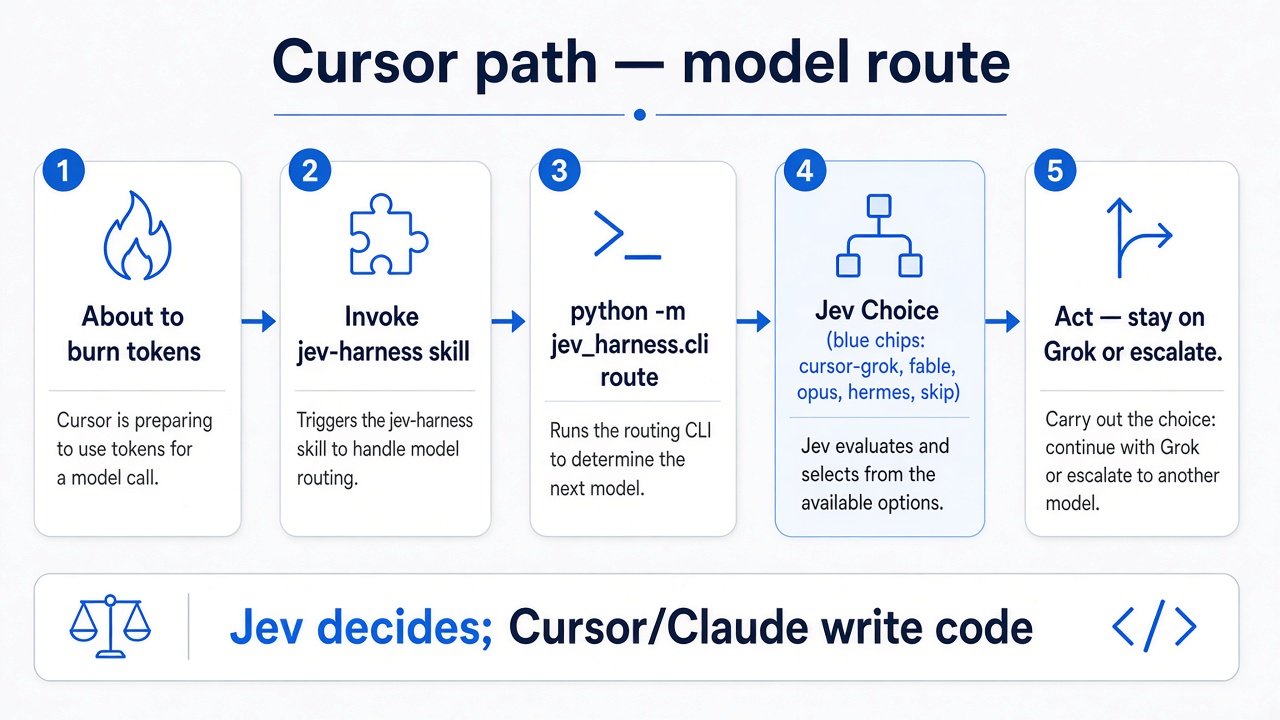
Example session. Goal: “small reconnect timeout fix in bridge.py.”
- Skill fires
cli routewith repo context. - Jev returns
cursor-grok, escalate false, Noul low. - Agent stays on Cursor Grok, edits the file, runs tests.
- Opus never opens. That is the whole point.
If the goal had been “Plan M7 fleet architecture,” we expect fable and a plan-only escalate — not an immediate impl blast.
Claude Code surface — multi-agent orchestrator
Claude Code gets the TypeSafe plugin installed, and repo CLAUDE.md turns the session into an orchestrator: cheap Claude builds state, calls Jev, spawns exactly one worker, merges, re-routes if incomplete. Implementation does not live in the orchestrator by default.
Agent Choice set (no cursor-grok — that stays on the Cursor surface):
| Choice | Spawn |
|---|---|
planner-fable |
Fable — plan only |
impl-opus |
Opus — hard impl |
impl-sonnet |
Sonnet — mid-tier coding |
review-fable |
Fable — diff / PR review |
research-hermes |
Hermes — long research/draft |
skip |
Scripts / tests / gh — no LLM |
python -m jev_harness.cli agent "Reduce E3 FA" \
  -c '{"phase":"plan","repo":"amr-agent","risk":"med"}'
Worker briefs live under /workspace/jev-harness/claude/briefs/. Planner output is plan-only; impl waits for a second route (phase=implement) or an explicit user GO. If confirm_upgrade is true (cheap Choice + Noul ≥ 0.55), confirm with the human before upgrading to Opus / planner Fable.
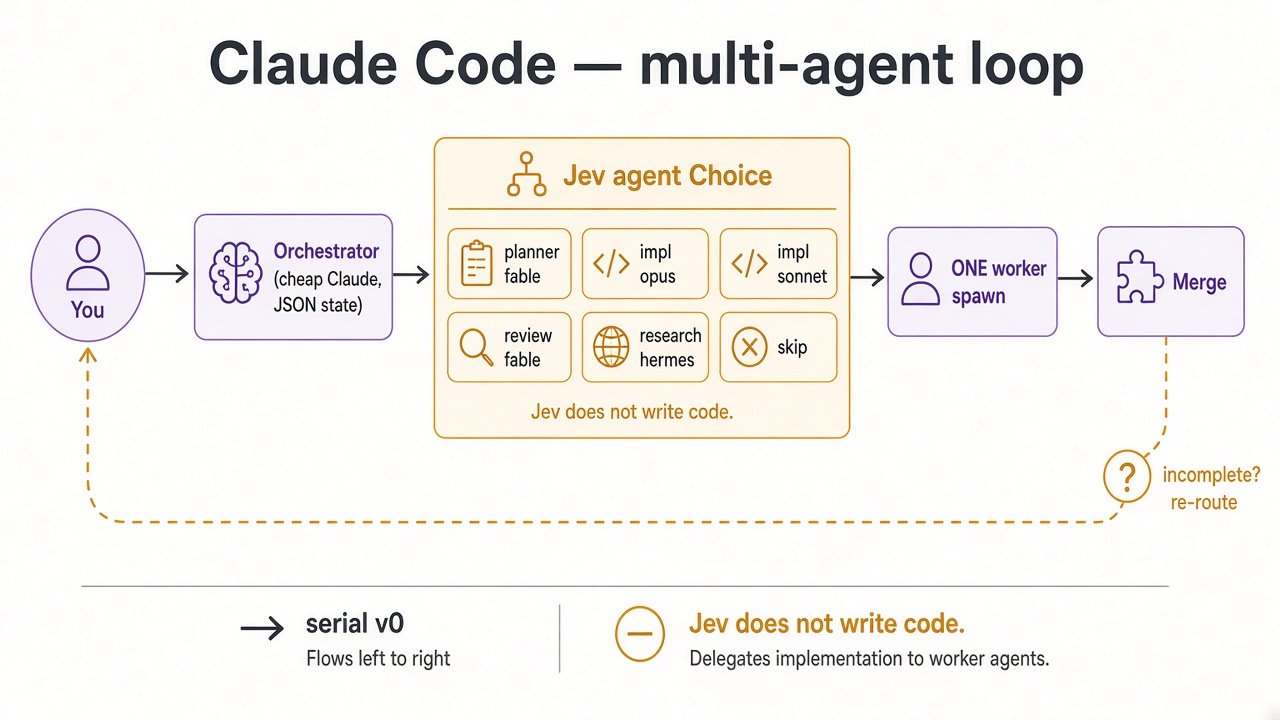
flowchart TD
  U["User goal"] --> O["Orchestrator builds compact state JSON"]
  O --> J["Jev cli agent / route_agent"]
  J -->|skip| T["Run tools / scripts"]
  J -->|planner-fable| P["Spawn Fable plan-only"]
  J -->|impl-opus / impl-sonnet| I["Spawn one impl worker"]
  J -->|review-fable| R["Spawn Fable review"]
  J -->|research-hermes| H["Spawn Hermes research"]
  P --> M["Merge result"]
  I --> M
  R --> M
  H --> M
  T --> M
  M -->|incomplete| O2["Update prior_agent / prior_outcome"]
  O2 --> J
  M -->|done or budget| S["Stop"]
Example: plan → impl → review
You say: “Drop E3 false aborts — plan first, then code.”
- Orchestrator state:
goal=reduce E3 FA,phase=plan,risk=med,repo=amr-agent. - Jev →
planner-fable. Only Fable spawns; brief says plan only. - Plan merges. State flips to
phase=implementwithprior_outcome. - Jev again →
impl-opusorimpl-sonnet. Exactly one impl worker. - Done coding →
phase=review→review-fable. - Anywhere along the way, if tests/scripts suffice, Jev can say
skipand no LLM opens.
Orchestrator is traffic cop. Jev is the light.
Side-by-side: what differs
| Cursor | Claude Code | |
|---|---|---|
| Gate API | cli route / route_task |
cli agent / route_agent |
| Choice includes Grok? | Yes — cursor-grok |
No |
| Session role | Coding agent gated by model pick | Orchestrator that spawns workers |
| Wiring | Cursor skill jev-harness |
CLAUDE.md + TypeSafe plugin |
| Parallel workers | N/A (single session) | Serial only in v0 |
| Typical escalate | Opus / Fable from Grok default | Opus only when Choice says so |
Same package. Same spend cap. Different closed sets because the products are different.
What we measured
Live smoke, model route (cli route), 10 cases, cap $0.50:
- Total proxy spend ≈ $0.00035
- Sensible picks across
cursor-grok/fable/opus/hermes/skip(fix → Grok, plan → Fable, hard PLC → Opus, pytest → skip)
Live smoke, agent route (cli agent), 9 labeled cases:
- 9/9 match expected worker ids
- Total proxy spend ≈ $0.00038 under the same $0.50 cap
Latency honesty from prior M5 (WAN Jev over public HTTP): p95 ~500 ms. That is fine for an async coding harness — you are already waiting on humans and editors. It is not fine for 3–5 Hz robot control loops. We do not claim tick-rate use here. Dollar figures are token proxies, not invoices.
What we do not use Jev for
- Writing code or free-text plans
- Vision / screenshot decisions
- Real-time control (latency already misses those budgets)
- Auto-spend without a hard USD cap
- Safety / ASIL / PL / SIL claims of any kind
Jev closes the schema. It can still pick the wrong legal option. The harness’s job is cheap routing and escalation discipline, not magic correctness.
How to try it
No secrets in this post. You need a TypeSafe API key in the environment (we load from ~/.config/typesafe.env on the box — never log it).
1. Package
cd /workspace/jev-harness   # or your sync path
python3 -m venv .venv && source .venv/bin/activate
pip install -r requirements.txt
export TYPESAFE_API_KEY=...   # your key
export JEV_HARNESS_CAP_USD=0.50
2. Cursor
- Install skill
jev-harnessfromcursor-skill/SKILL.md - Keep upstream
typesafe-aiskill from github.com/typesafe-ai/skills for designing new judgments
3. Claude Code
# upstream skill / plugin (pick one method)
npx skills add typesafe-ai/skills --skill typesafe-ai
# or: claude plugin marketplace add typesafe-ai/skills
#     claude plugin install typesafe@typesafe-ai
Append /workspace/jev-harness/claude/CLAUDE.md.snippet into the repo’s CLAUDE.md so the session is an orchestrator.
4. One-liners
python -m jev_harness.cli route "Fix reconnect timeout in bridge.py"
python -m jev_harness.cli agent "Reduce E3 FA" \
  -c '{"phase":"plan","repo":"amr-agent","risk":"med"}'
python -m jev_harness.cli spend
Offline: JEV_HARNESS_MOCK=1 for deterministic tests without spend.
Closing — programmable common sense before generation
Expensive models as the default is wasteful. A typed System One gate is programmable common sense: closed options, code-owned control flow, escalate only when the cheap judgment says so.
Same jev-harness package. Cursor gets a model router. Claude Code gets a ratified multi-agent orchestrator where Jev picks the next worker. Serial, JSON-only, no vision, hard spend cap.
That is the harness. Generation stays expensive on purpose — and rare when it should be.