A robot that learns to navigate — from scratch
A TurtleBot3 starts with zero knowledge about its environment. Through thousands of episodes of trial and error, it learns when to go forward, when to turn, and how to avoid obstacles — no pre-programmed paths, no map, just pure reinforcement learning.
This was my Master's thesis project at the University of Europe, Berlin. The goal: implement and systematically evaluate Q-Learning for autonomous robot navigation in a simulated Gazebo environment.
How it works
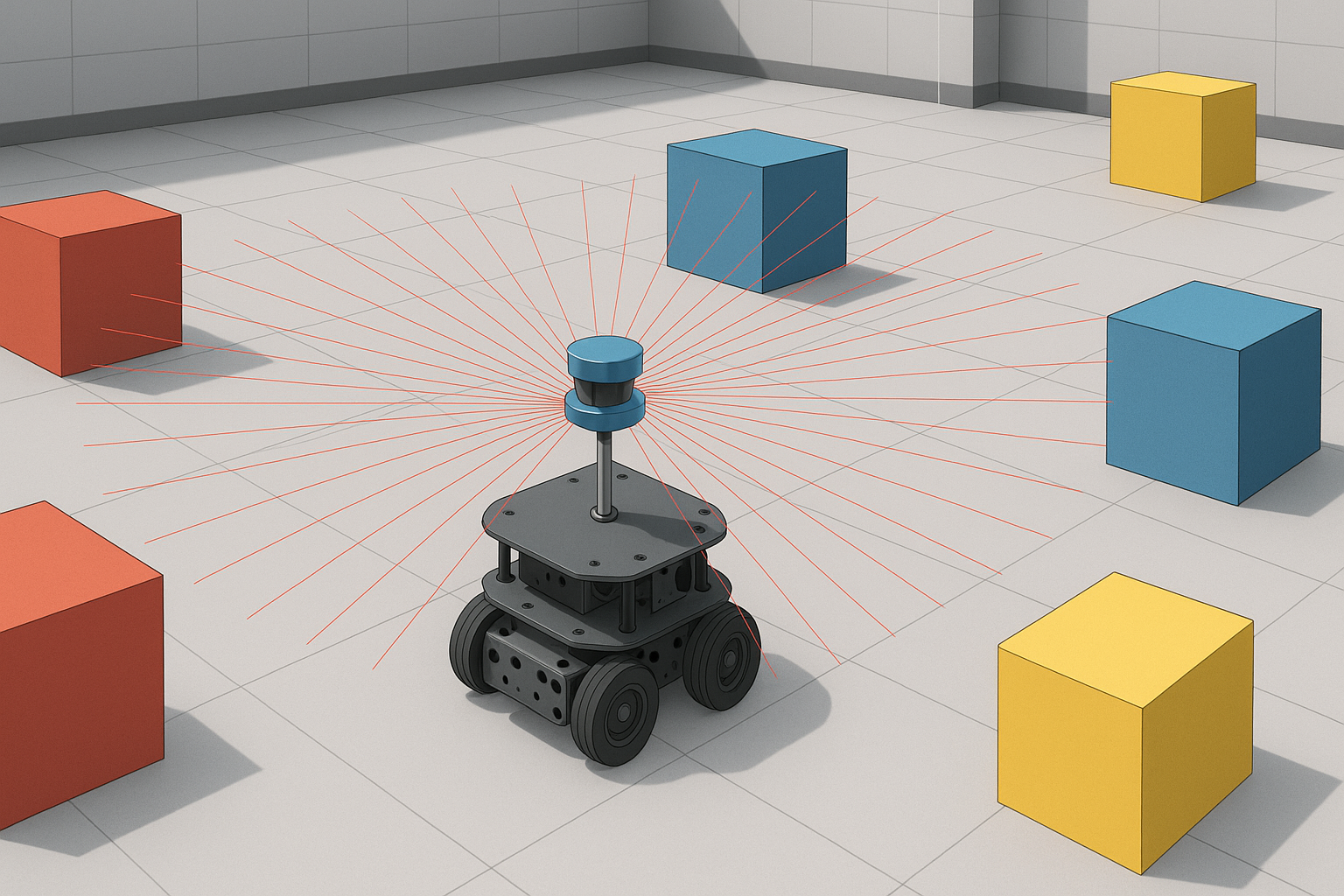
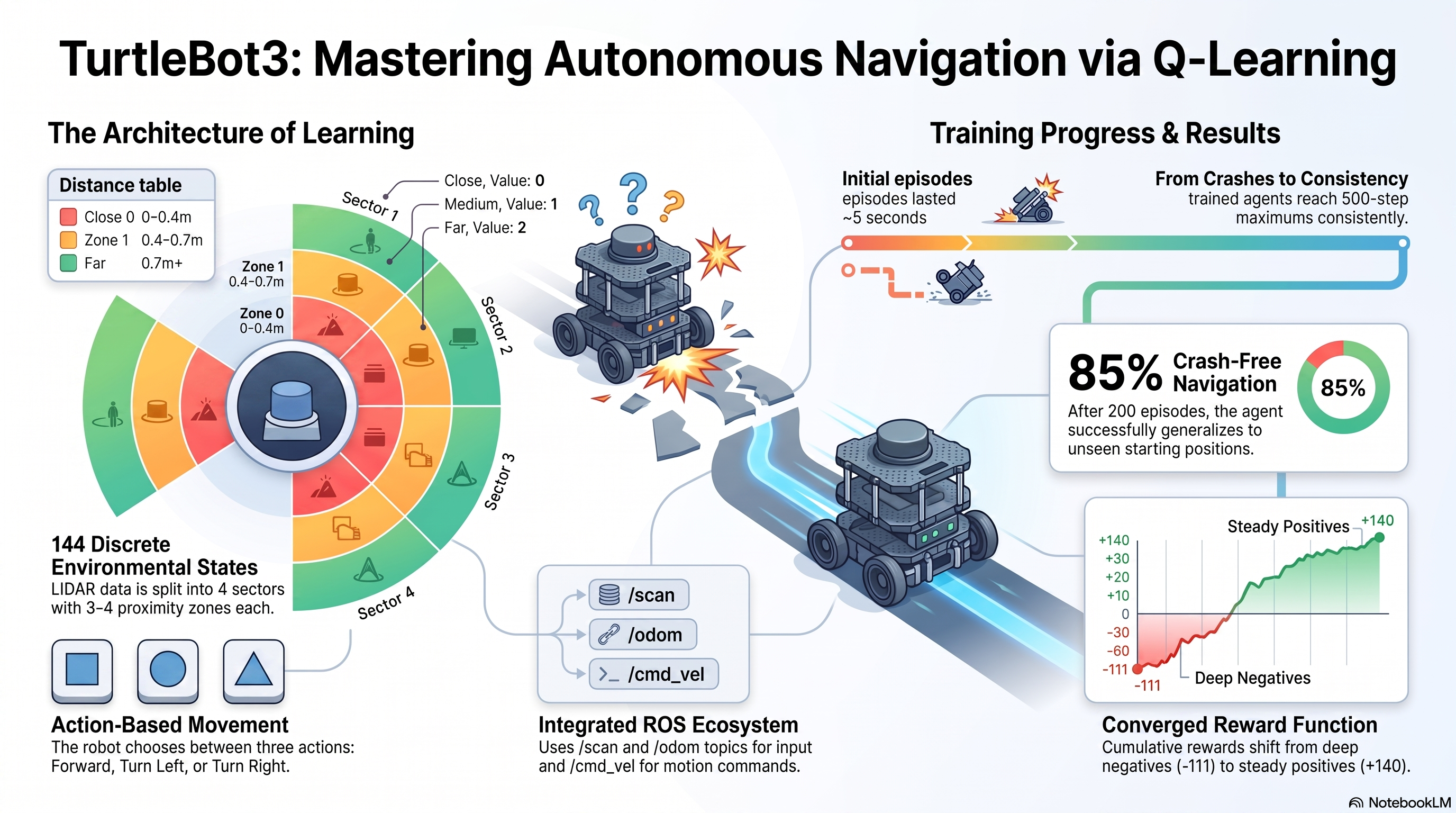
The robot uses a 360° LIDAR sensor to perceive its surroundings. The continuous sensor data is discretized into 144 states based on four spatial features:
| Feature | Region | Zones | Purpose |
|---|---|---|---|
| x1 | Left (0-75°) | 3 | Left obstacle proximity |
| x2 | Right (285-360°) | 3 | Right obstacle proximity |
| x3 | Front-left (0-75°) | 4 | Front-left sector detail |
| x4 | Front-right (285-360°) | 4 | Front-right sector detail |
Three simple actions: forward (0.08 m/s), turn left (+0.4 rad/s), turn right (-0.4 rad/s).
The reward function balances progress against safety:
R = R_action + R_obstacle + R_change

Forward: +0.4    Turn: -0.2
Closer to obstacle: -0.4    Away from obstacle: +0.4
Oscillation (left→right→left): -0.4
Crash: -100 (episode terminates)
Exploration strategies
Two strategies were implemented and compared across all experiments:
- Softmax (Boltzmann) — Probabilistic action selection based on Q-values with temperature decay (T_init=25, decay=0.95)
- ε-greedy — Random exploration with decaying epsilon (ε_init=0.6, decay=0.998)
Experimental design
20 configurations were trained and evaluated:
| Exploration | Start position | Scenarios | Episodes each |
|---|---|---|---|
| Softmax | Random | 5 | 200 |
| Softmax | Fixed | 5 | 200 |
| ε-greedy | Random | 5 | 200 |
| ε-greedy | Fixed | 5 | 200 |
Hyperparameter scenarios
| Scenario | α (learning rate) | γ (discount) | Strategy |
|---|---|---|---|
| 1 — Moderate | 0.5 | 0.9 | Balanced baseline |
| 2 — Fast/High Explore | 0.7 | 0.8 | Quick learning, lots of exploration |
| 3 — Fast/Low Explore | 0.7 | 0.85 | Quick learning, focused |
| 4 — Slow/High Explore | 0.3 | 0.95 | Patient learning, thorough exploration |
| 5 — Slow/Low Explore | 0.2 | 0.7 | Conservative approach |
Results
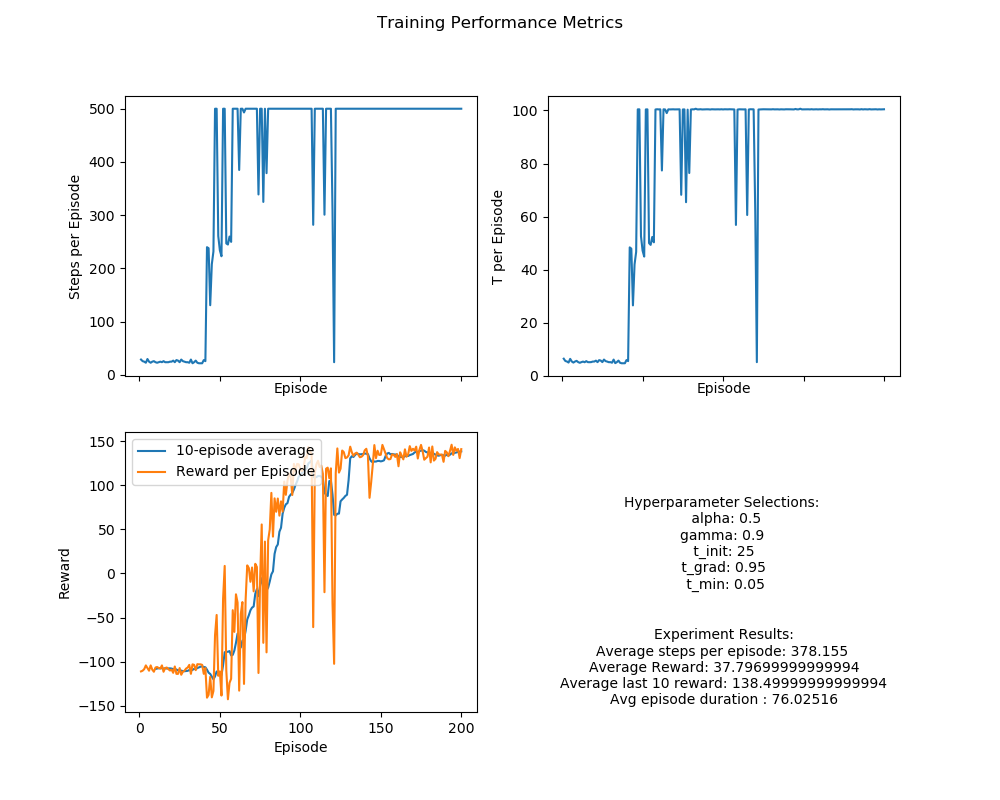
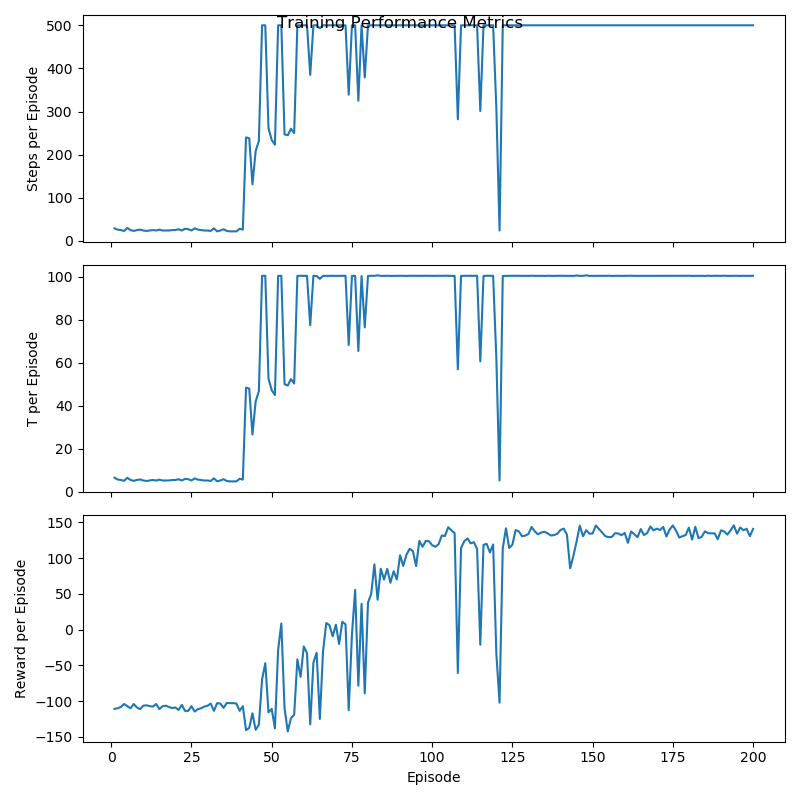
After training, the agent achieves:
- ~85% crash-free navigation in test scenarios
- Smooth obstacle avoidance without oscillation
- Generalization to unseen starting positions
Comparing exploration strategies
The ε-greedy strategy with moderate hyperparameters (α=0.5, γ=0.9) shows steady learning with occasional exploration spikes:
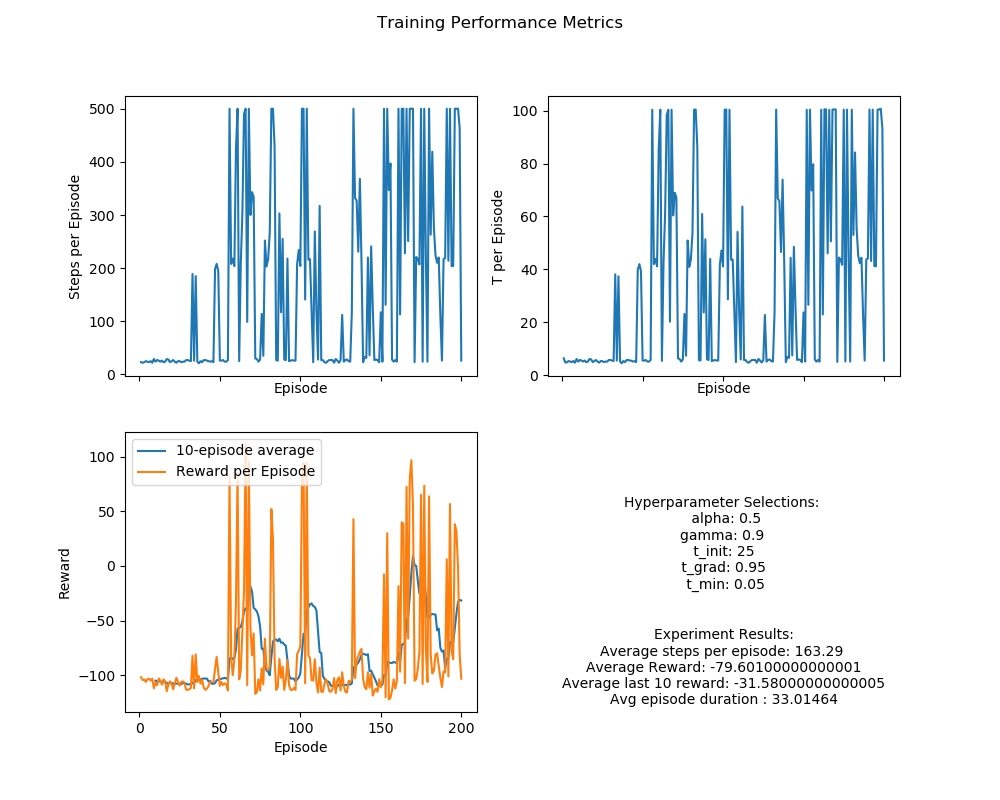
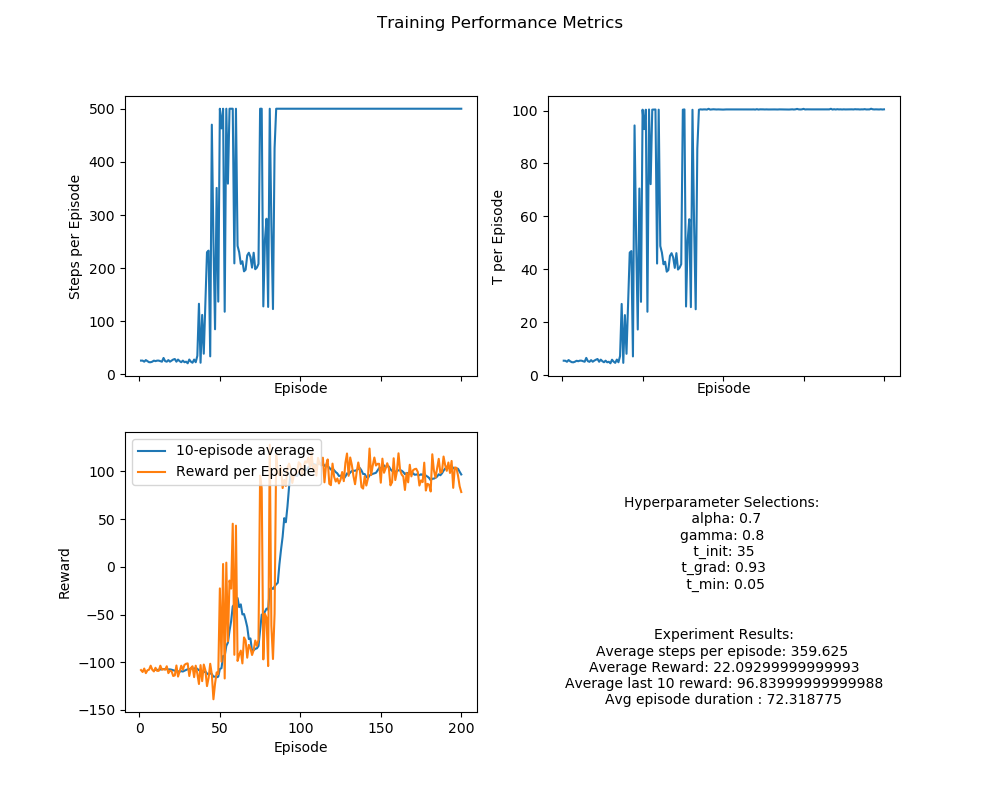
Fast learning with high exploration (α=0.7, γ=0.8) converges faster but with more variance:
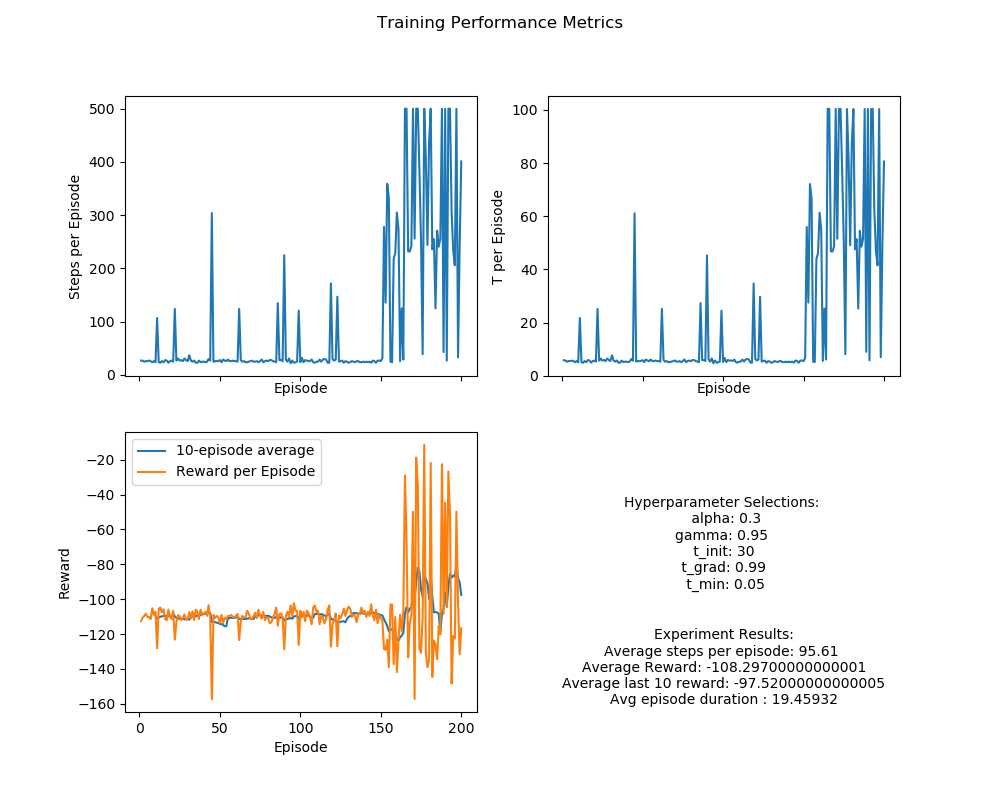
Slow learning with thorough exploration (α=0.3, γ=0.95) produces the most stable convergence:
Project overview
Architecture
The system follows a clean inheritance hierarchy — each layer extends the previous, adding a specific concern:
Lidar (lidar_scanner.py)
  ↓ inherits
QLearning (q_learning.py)
  ↓ inherits
Control (controller.py)
  ↓ inherits
MapLearner (learning_manager.py)
- Lidar: Raw 360° sensor processing and state discretization
- QLearning: Q-table operations, Softmax/ε-greedy exploration, reward calculation
- Control: ROS
/cmd_velpublishing, position management, action execution - MapLearner: Episode management, training loop, data logging
ROS topics
| Topic | Type | Direction | Purpose |
|---|---|---|---|
/scan |
sensor_msgs/LaserScan |
Subscribe | 360° LIDAR data |
/odom |
nav_msgs/Odometry |
Subscribe | Robot pose |
/cmd_vel |
geometry_msgs/Twist |
Publish | Velocity commands |
/gazebo/set_model_state |
gazebo_msgs/ModelState |
Publish | Robot reset |
Reproducibility
The entire pipeline runs in Docker — no local ROS installation needed:
docker-compose up --build
All 20 experiment configurations, Q-tables, training curves, and analysis notebooks are included in the repository.
Stack
PyTorch · ROS Noetic · Gazebo 11 · Python 3.8+ · Docker · NumPy · Pandas · Matplotlib